




Discover why a thorough facial assessment is the key to natural, safe non-surgical results. Learn the methods, questions to ask, and how bespoke planning works.

Most women who walk into an aesthetic clinic already know what they want to change. What they don’t always know is that the quality of their results depends far less on which filler is used and far more on what happens before a single needle is picked up. Facial assessment is the foundational step in non-surgical aesthetics, enabling truly personalised treatment plans rather than generic protocols applied to every face. The idea that fillers are a one-size-fits-all solution is one of the most persistent myths in aesthetics, and it’s worth setting the record straight.
Table of Contents
- Why facial assessment matters in non-surgical aesthetics
- Modern facial assessment approaches explained
- Personalising your treatment: from assessment to plan
- Understanding nuances: etiology, severity, and gender-tailored approaches
- Making your facial assessment count: tips for the best results
- Ready for a bespoke consultation at Monaz Clinic?
- Frequently asked questions
Key Takeaways
| Point | Details |
|---|---|
| Personalisation drives results | A thorough facial assessment means your aesthetic plan is bespoke to your features and expectations for the most flattering and natural look. |
| Modern methods are best | Cutting-edge 3D and AI tools help London clinics provide safer, more effective, and longer-lasting outcomes. |
| Questions matter | Knowing what to ask during assessment empowers you to make informed choices and avoid common pitfalls. |
| Gender-tailored approaches | Women’s plans focus on enhancing softness and femininity for a subtly refreshed appearance. |
Why facial assessment matters in non-surgical aesthetics
A thorough facial assessment is not a formality. It is the difference between a result that looks refreshed and one that looks done. When a practitioner takes the time to evaluate your anatomy, the signs of ageing specific to your face, your lifestyle, and your personal goals, the treatment plan that follows is built around you, not a template.
Personalised treatment plans are what separate high-satisfaction outcomes from disappointing ones. Research consistently shows that etiology-tailored treatments deliver durability of 12 to 18 months alongside high patient satisfaction, whereas generic approaches frequently lead to over-treatment or imbalance. Over-treatment is not just an aesthetic problem. It can affect how naturally your face moves and ages over time.
A well-structured assessment considers several layers of information:
- Anatomy: bone structure, fat compartments, muscle activity, and skin quality
- Ageing signs: whether volume loss, skin laxity, or dynamic lines are the primary concern
- Lifestyle factors: sun exposure, stress, sleep, and skincare habits
- Expectations: what you want to achieve and what is realistically achievable
- Medical history: contraindications, previous treatments, and skin sensitivities
“The goal is never to standardise beauty. It is to understand each woman’s face well enough to restore what time has quietly taken away.”
You can explore what a thorough facial assessment checklist looks like in practice, or read more about the range of non-invasive treatments that a good assessment can inform. With the foundational importance of assessment clear, let’s explore what actually happens during a modern facial analysis.
Modern facial assessment approaches explained
The days of a practitioner simply looking at your face and deciding where to inject are long gone. Today’s leading clinics use structured, science-backed frameworks to ensure nothing is missed and nothing is assumed.
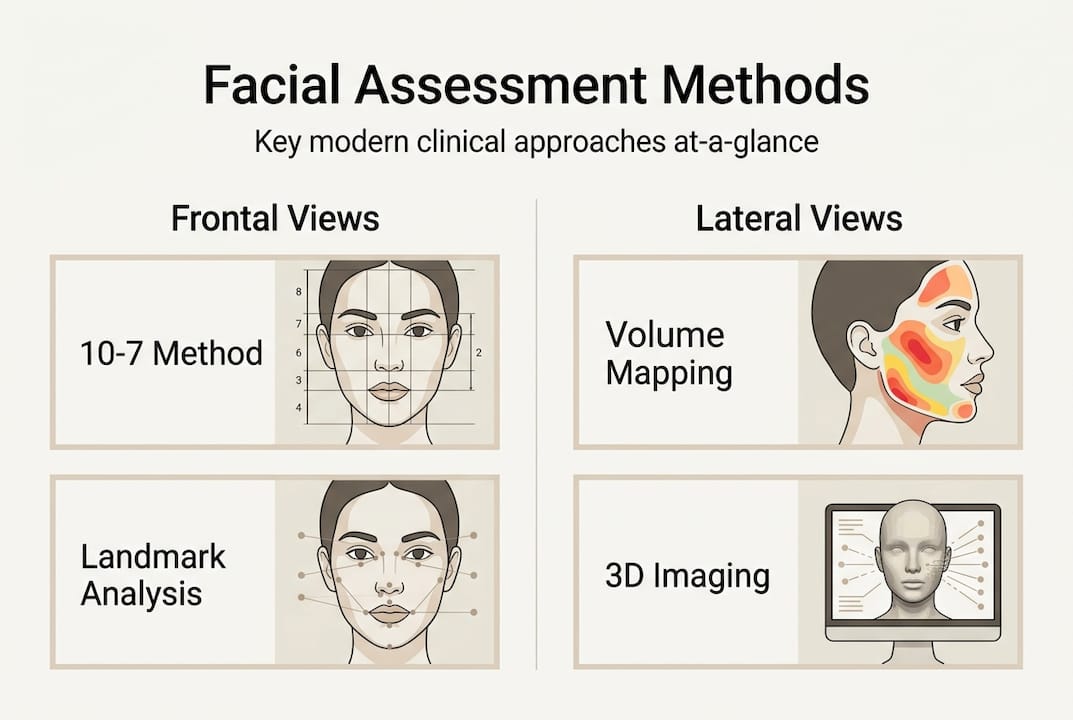
One of the most rigorous is the 10-7 method, which involves 10 frontal views and 7 lateral views, systematically assessing key facial regions including bone, ligaments, muscles, fat compartments, and skin layers. This panfacial approach means your practitioner is not just looking at the fold or line you’re concerned about. They are reading your face as a whole, interconnected structure.
Here is a summary of the main assessment frameworks used in modern aesthetic practice:
| Framework | What it evaluates | Key benefit |
|---|---|---|
| 10-7 method | 10 frontal, 7 lateral views across all facial layers | Systematic, nothing overlooked |
| Panfacial approach | Bone, ligaments, fat, muscle, skin as a system | Holistic, prevents patchwork results |
| Merz Aesthetics Scales (MAS) | Standardised grading of folds, lines, and volume | Consistent severity scoring |
| 3D imaging (e.g., Visia 7) | Objective skin metrics, texture, pigmentation | Reduces subjective bias |
Objective tools such as 3D imaging and AI-driven skin analysis are increasingly important. AI and 3D technology shift the process from subjective impression to reproducible data, reducing variability between appointments and between practitioners. This matters enormously when you are planning a course of treatments over time.
A typical structured assessment follows these stages:
- Initial consultation: listening to your concerns, reviewing medical history, discussing goals
- Multi-angle photography: capturing your face at rest and in motion from multiple angles
- Layered analysis: evaluating bone, fat, muscle, and skin individually and together
- Objective measurement: using digital tools or 3D imaging where available
- Treatment mapping: identifying which areas to address, in which order, and with which techniques
Pro Tip: An in-person, multidimensional evaluation will always outperform any app-based or selfie-driven assessment. Apps cannot assess muscle movement, skin texture under different lighting, or the subtle asymmetries that a trained eye catches in person.
You can read more about what to expect from a step-by-step dermal filler consultation or use a dermal filler checklist to prepare your questions in advance. After learning the science behind the assessment, discover how findings directly shape your personalised non-surgical plan.
Personalising your treatment: from assessment to plan
Knowing what needs addressing is only half the picture. The other half is knowing how to address it, and that is where the assessment findings translate into a bespoke protocol.
Take nasolabial folds as an example. These are the lines that run from the sides of the nose to the corners of the mouth. They look similar on many faces, but their causes differ significantly. Some are driven by volume loss in the cheeks. Others are caused by skin laxity. Some are deepened by muscle activity. The treatment approach for each is different, and HA filler protocols reflect this directly:
| Protocol | Approach | Best suited for |
|---|---|---|
| Protocol 1 | Direct superficial filler | Mild, skin-level folds |
| Protocol 2 | Dual-plane cheek injection | Volume-driven folds |
| Protocol 3 | Indirect lift plus direct | Moderate, mixed-cause folds |
| Protocol 4 | Temple and jaw augmentation first | Structural, skeletal-driven folds |
For women seeking their first comprehensive treatment, or those who want longer-lasting results, sequential BoNT-A pretreatment offers a particularly effective approach. By weakening depressor muscles before fillers are placed, this method enhances precision, extends longevity, and reduces the risk of filler migration. It is a good example of how a well-assessed plan can do more with less.
For women specifically, subtlety is almost always the right direction. The goal is to restore a natural softness, not to add volume for its own sake. A good assessment will identify:
- Which areas have genuinely lost volume versus which have simply shifted
- Whether skin quality treatments should precede or accompany injectable work
- How anti-wrinkle injections and fillers can be sequenced for the best combined result
- Whether a single-area treatment or a panfacial approach will serve you better
Pro Tip: Ask your practitioner whether their assessment included evaluation of your muscle activity, fat compartments, and bone structure. If the answer is no, the plan may not be as precise as it could be.
Learn more about filler types for natural results, read tips for natural-looking filler, or explore the broader role of dermal fillers in a well-rounded aesthetic plan. With the assessment-to-plan journey explained, let’s clarify the subtle differences and common pitfalls in facial evaluation methods.
Understanding nuances: etiology, severity, and gender-tailored approaches
One of the most important distinctions in facial assessment is the difference between etiology and severity. Severity tells you how deep a fold is or how much volume has been lost. Etiology tells you why. Treating severity without understanding etiology is like painting over damp walls. The result looks fine briefly, then the problem returns.
Distinguishing etiology from severity is especially important for women, because the causes of facial ageing in women differ from those in men. Women tend to experience more pronounced volume redistribution in the mid-face, changes in skin elasticity linked to hormonal shifts, and a natural facial shape that benefits from subtle, heart-shaped contouring rather than angular definition.
“A plan built around your etiology, not just your grade on a severity scale, is what produces results that still look like you.”
Gender-tailored assessment actively guards against masculinisation. Avoiding over-volumisation and prioritising indirect lifting techniques over direct volume addition are hallmarks of a female-focused approach. This is not a minor detail. It is the reason some women leave a clinic looking refreshed and others leave looking altered.
The debate between traditional visual grading versus AI-assisted objective analysis is also worth understanding. Traditional grading relies on a practitioner’s trained eye, which is valuable but inherently subjective. AI and 3D tools add a layer of reproducibility that benefits you across multiple appointments. The best clinics use both.
Key things to look for when evaluating a clinic’s assessment approach:
- Do they assess your face at rest and in motion?
- Do they discuss the cause of your concerns, not just the appearance?
- Do they use photography or imaging as part of the process?
- Do they explain why they are recommending a particular treatment?
- Do they ever suggest doing less rather than more?
Read more about the benefits of dermal fillers when they are placed within a properly assessed, gender-tailored plan. Now you know why a bespoke facial assessment changes everything, here’s how to make it work for you in practice.
Making your facial assessment count: tips for the best results
Knowing that a good assessment matters is one thing. Walking into a consultation prepared to get the most from it is another. Here is how to approach your appointment with confidence.
- Write down your concerns before you go. Be specific. “I look tired” is a starting point, but “I notice hollowness under my eyes and my cheeks feel flatter than they used to” gives your practitioner far more to work with.
- Bring photographs if you have them. A photo of yourself from five or ten years ago can be genuinely useful. It shows your practitioner your natural proportions before ageing changes took hold.
- Ask about the assessment process directly. A practitioner who can explain their method clearly, including which layers of the face they evaluate and why, is one who has thought carefully about your safety.
- Discuss maintenance and follow-up. A personalised plan is not a one-off event. Understanding how your results will evolve and when to return helps you protect your investment.
- Set realistic expectations together. The best outcomes come from honest conversations about what is achievable, not from agreeing with everything a practitioner suggests.
Pro Tip: Prioritise clinics that offer 3D imaging or detailed photographic analysis as part of their assessment. This level of transparency means your practitioner can show you, not just tell you, what they are planning and why.
If you are ready to explore what a truly personalised approach looks like, our full facial rejuvenation service is a good place to start. With these practical tips, you’re ready to confidently take the next step in your facial aesthetic journey.
Ready for a bespoke consultation at Monaz Clinic?
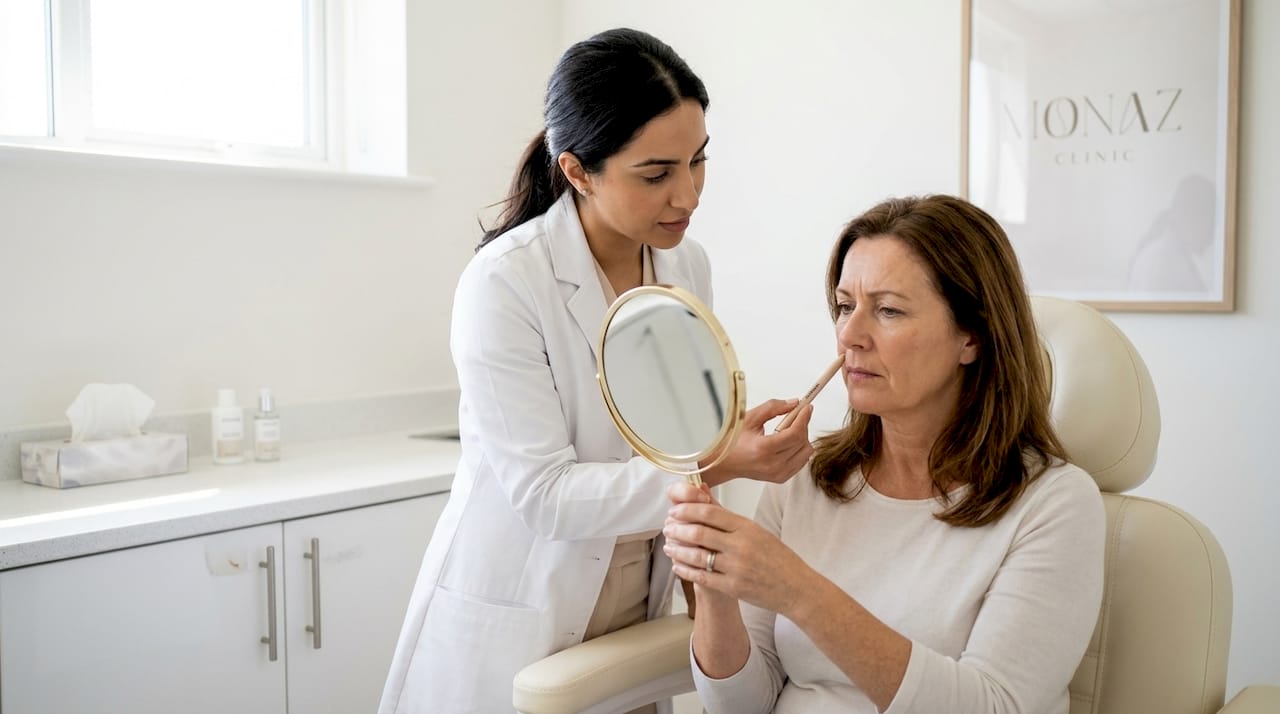
At Monaz Clinic, 96 Harley Street, every treatment begins with exactly the kind of thorough, structured assessment this article has described. Mrs Mona Zirak and our GMC-registered clinical team take the time to understand your anatomy, your goals, and your concerns before any plan is formed. We believe that the assessment is the treatment, in the sense that everything that follows depends on getting it right.
Our full facial rejuvenation service brings together the most appropriate combination of injectables, skin boosters, and rejuvenation treatments for your unique face. There is no pressure, no upselling, and no generic protocols. You can review our treatment pricing in full before your appointment. Book your complimentary consultation today and experience what a genuinely personalised approach feels like.
Frequently asked questions
What is the main goal of a facial assessment before non-surgical treatments?
A facial assessment ensures your treatment is tailored to your individual features and goals, making results both natural and safe. The foundational role of assessment is to prevent generic protocols and support long-term satisfaction.
How has technology changed facial assessments in London clinics?
Advanced 3D imaging and AI tools now provide objective, reproducible analysis that improves accuracy across appointments. AI and 3D methods shift evaluation from subjective impression to consistent, measurable data.
Can facial assessment prevent unnatural results or filler migration?
Yes. A thorough assessment maps your anatomy before treatment, reducing the risk of filler migration and helping avoid results that look overdone. Proper assessment mitigates migration risk in dynamic facial areas.
How are treatments tailored for women compared to men?
Women’s plans typically prioritise subtle contouring, heart-shaped facial balance, and indirect volumisation to avoid masculinisation. Gender-specific planning is a core part of a female-focused aesthetic approach.
What questions should I ask my practitioner during a facial assessment?
Ask about their assessment method, whether they evaluate multiple facial layers, and how your plan is tailored to your anatomy. Systematic multi-layer analysis covering bone, fat, muscle, and skin is the standard you should expect.
Recommended
- Facial Assessment Checklist for Natural-Looking Results – Monaz Clinic London
- How to Personalise Facial Aesthetics Naturally for Women – Monaz Clinic London
- 7 Signs You Need Facial Aesthetics Naturally Explained – Monaz Clinic London
- When to Start Facial Treatments: Your Ideal Guide – Monaz Clinic London