




Considering nasolabial folds? Learn how dermal fillers work, different filler types, the treatment process, medical safety, and natural aesthetic benefits.

Noticing your smile lines becoming more pronounced as the years pass can sometimes feel discouraging, especially when you value natural beauty and healthy skin. For women in London eager to soften nasolabial folds without drastic methods, science offers safe, effective treatments grounded in a deep understanding of facial ageing. This article reveals how hyaluronic acid fillers offer excellent safety records, restore lost volume, and help you achieve refreshed results that still look like you.
Table of Contents
- Nasolabial Folds And Dermal Filler Science
- Types Of Dermal Fillers For Smile Lines
- How Treatment Softens Nasolabial Folds
- Safety, Aftercare And Achieving Natural Results
Key Takeaways
| Point | Details |
|---|---|
| Understanding Nasolabial Folds | Nasolabial folds deepen over time due to facial volume loss and weakening support structures, primarily caused by ageing and gravity. |
| Effectiveness of Dermal Fillers | Dermal fillers effectively restore lost volume beneath the skin, leading to natural-looking results that soften folds without a frozen appearance. |
| Safety and Aftercare | Following proper consultation and aftercare significantly enhances safety and results, minimising common side effects like swelling and bruising. |
| Choosing the Right Filler | The choice of dermal filler depends on desired outcomes and facial features, with options including Hyaluronic Acid, Calcium Hydroxylapatite, and others that cater to varying needs. |
Nasolabial Folds and Dermal Filler Science
Nasolabial folds form due to a combination of facial volume loss and weakening ligaments that naturally occur with age. These lines run from the corners of your nose to the edges of your mouth, deepening as your skin loses elasticity and your facial structure shifts downwards over time.
Understanding how nasolabial folds develop helps explain why dermal fillers work so effectively. Rather than treating just the surface wrinkle, fillers restore lost volume beneath the skin, lifting and softening the fold from within.
Why Folds Deepen Over Time
Your face contains structural support systems—ligaments, fat pads, and collagen fibres—that maintain skin firmness. As you age, these structures naturally weaken and shrink, causing your skin to lose its internal scaffolding.
Gravity also plays a role. Your facial tissues gradually shift downward, creating more pronounced folds where your cheeks meet your mouth area. This process typically becomes noticeable between your 30s and 40s, though timing varies significantly.
Volume loss occurs not just in the fold itself, but throughout your midface. When cheeks and temples flatten, the nasolabial fold becomes more prominent by comparison.
How Dermal Fillers Address the Problem
Dermal fillers work by:
- Replacing lost volume in the fold area directly
- Lifting surrounding cheek tissue to reduce fold depth
- Restoring facial balance and proportion
- Stimulating natural collagen production (with certain filler types)
Crosslinked hyaluronic acid fillers have become the preferred choice for nasolabial fold treatment. Hyaluronic acid (HA) is a naturally occurring substance in your skin that holds water, creating volume and hydration.

When injected, HA fillers integrate with your surrounding tissue, creating a smooth transition that looks natural. The crosslinking process makes the filler last longer by preventing your body from breaking it down too quickly.
Safety and Efficacy Profile
HA fillers demonstrate excellent safety records, with fewer adverse events compared to other filler types like bovine collagen or poly (L-lactic acid). Serious complications are rare when administered by experienced practitioners.
Common, mild side effects include:
- Temporary redness or swelling
- Minor bruising at injection sites
- Brief tenderness
These typically resolve within a few days. More serious complications, such as nodule formation or vascular compromise, occur very rarely with modern techniques.
Quality matters significantly. Medical-grade HA fillers from reputable manufacturers show superior safety profiles and longer-lasting results than lower-grade alternatives.
Patient Satisfaction and Results
Clinical trials show that most patients experience meaningful improvement in fold appearance within days, with optimal results visible after one to two weeks as swelling subsides. Results typically last six to eighteen months, depending on the specific filler type and your individual metabolism.
Patient satisfaction remains high because fillers restore natural-looking volume without the “frozen” appearance associated with other treatments. Your face continues to move naturally whilst the fold softens.
Pro tip: Schedule your treatment for midweek if possible, allowing any minor swelling to resolve before weekend social commitments.
Types of Dermal Fillers for Smile Lines
Not all dermal fillers are created equal. Different formulations offer varying levels of effectiveness, duration, and aesthetic outcomes when treating nasolabial folds. Choosing the right filler type depends on your specific needs, skin condition, and desired results.
Your practitioner will recommend a filler based on fold depth, skin quality, and how long you want results to last. Some fillers integrate more smoothly with your tissue, whilst others provide firmer support for deeper lines.
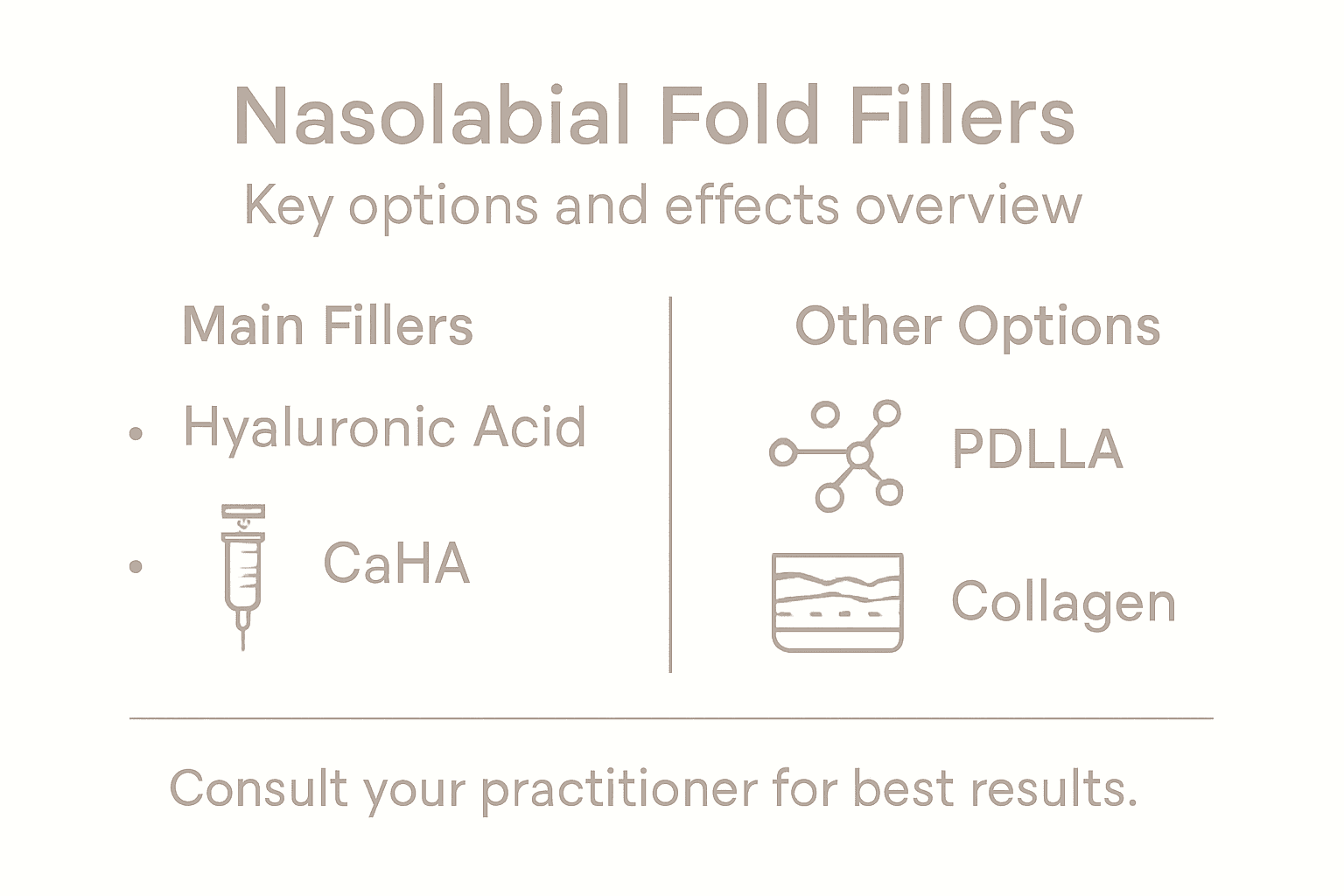
Hyaluronic Acid Fillers
Hyaluronic acid (HA) remains the most widely used filler for smile lines because it mimics a substance naturally present in your skin. When injected, HA attracts water molecules, creating volume that lifts and softens nasolabial folds from within.
HA fillers come in different densities and crosslinking structures. Lighter formulations work better for subtle lines, whilst denser versions provide stronger support for pronounced folds.
Key advantages include:
- Reversible with hyaluronidase if needed
- Natural integration with surrounding tissue
- Lower risk of nodule formation
- Excellent safety profile across diverse patient types
Different HA filler formulations show similar safety outcomes but may differ in texture and feel beneath the skin. Some formulations yield softer results, whilst others provide firmer support.
Results typically last six to twelve months, depending on your metabolism and the specific product used.
Calcium Hydroxylapatite (CaHA) Fillers
Calcium hydroxylapatite is a mineral compound that stimulates your body to produce collagen whilst providing immediate volume. It consists of tiny microspheres suspended in a gel base that gradually biodegrades over time.
CaHA fillers offer longer-lasting results than standard HA products. Clinical studies show superior effectiveness at six to nine months compared to other filler types, making them ideal if you prefer fewer touch-ups.
Benefits include:
- Results lasting twelve to eighteen months
- Collagen-stimulating properties
- Firmer support for moderate-to-severe folds
- Compatible with combining treatments
Comparative filler studies demonstrate that CaHA provides stronger fold correction and longer duration than many alternatives. However, it feels slightly firmer than HA and requires careful placement to maintain natural aesthetics.
Poly-d,l-Lactic Acid (PDLLA) and Collagen Options
Poly-d,l-lactic acid works similarly to calcium hydroxylapatite by stimulating collagen production. Results develop gradually over weeks, creating a more subtle, progressive improvement rather than immediate volume.
Traditional bovine and human collagen fillers offer natural-looking results but typically last only three to four months. They’re less commonly used today because newer options provide longer duration with fewer adverse events.
Comparison of filler longevity:
Here’s a concise overview of how common dermal filler types for nasolabial folds differ:
| Filler Type | Typical Duration | Main Benefit | Ideal For |
|---|---|---|---|
| Hyaluronic Acid (HA) | 6–12 months | Natural tissue blending | Mild to moderate folds |
| Calcium Hydroxylapatite | 12–18 months | Collagen stimulation | Moderate to deep folds |
| Poly-d,l-lactic acid | 9–18 months | Gradual improvement | Progressive correction |
| Collagen (bovine/human) | 3–4 months | Soft, subtle effect | Temporary enhancement |
- Hyaluronic acid: six to twelve months
- Poly-d,l-lactic acid: nine to eighteen months
- Calcium hydroxylapatite: twelve to eighteen months
- Collagen: three to four months
Your ideal filler depends on balancing three factors: how natural you want results to look, how long you want them to last, and your comfort with filler firmness beneath the skin.
Choosing Your Filler Type
The best filler for your nasolabial folds depends on fold severity, skin texture, and your aesthetic preferences. Shallow lines respond beautifully to lighter HA formulations, whilst deeper folds benefit from firmer options like calcium hydroxylapatite.
Your practitioner will assess your unique facial anatomy during consultation. They’ll determine whether you need volume in the fold itself, lifting of surrounding cheek tissue, or a combination approach.
Pro tip: Ask your practitioner about their experience with different filler types for your specific fold depth, and request before-and-after photos showing natural-looking results in patients with similar anatomy to yours.
How Treatment Softens Nasolabial Folds
Dermal filler treatment works by addressing the root cause of nasolabial folds: lost volume and weakened structural support beneath your skin. Rather than simply smoothing the surface, fillers restore the underlying architecture that keeps your face looking youthful and lifted.
The softening process happens through precise placement and strategic volume restoration. Your practitioner uses their knowledge of facial anatomy to inject filler exactly where it creates the most natural lift and fold reduction.
Direct Volume Replacement
The primary mechanism involves replacing volume lost to ageing. When filler material is injected into the nasolabial fold itself, it physically fills the depression, making the line less noticeable.
This isn’t simply about filling a crease. The filler integrates with your surrounding tissue, creating a smooth transition from fold to cheek. This blended integration is what produces natural-looking results rather than obvious, artificial fullness.
Direct fold treatment addresses:
- The depth of the crease itself
- The sharp definition that makes folds visible
- Surface irregularities in the fold line
- Loss of skin elasticity within the fold area
Strategic Cheek Lifting
Many practitioners use a technique that goes beyond treating the fold itself. By restoring volume to your cheeks and midface, they lift surrounding tissue, which naturally reduces fold prominence from above.
Think of it like lifting a curtain. When you lift the fabric higher, the wrinkles in the lower portion become less pronounced. Similarly, cheek volume restoration raises your facial contours, softening the appearance of nasolabial folds without necessarily filling them completely.
This approach offers several advantages:
- More natural results that reflect your face’s natural contours
- Improved facial balance and proportion
- Longer-lasting effects through structural support
- Less obvious filler placement
How Your Body Responds
Understanding how dermal fillers work helps explain why results appear gradually. When filler is injected, your body begins integrating it immediately with surrounding tissue.
With hyaluronic acid fillers, water absorption occurs over the first week, causing initial swelling to resolve. Your face settles into its final appearance around two weeks post-treatment.
Collagen-stimulating fillers work differently. They trigger your body’s natural healing response, encouraging collagen production over weeks. Results build gradually, becoming more pronounced over time rather than appearing immediately.
Texture and Natural Movement
Quality filler placement ensures your face maintains natural movement. Your nasolabial folds should soften whilst still allowing your face to express emotion and movement.
This is why technique matters tremendously. Experienced practitioners use appropriate filler viscosity, placement depth, and volume to soften folds whilst preserving your natural facial dynamics and expressiveness.
The best filler result is one people cannot identify as filler—they simply notice you look refreshed and well-rested.
Longevity and Progressive Softening
Results continue improving subtly over weeks as swelling resolves and filler fully integrates. The initial improvement is dramatic, but true softening develops as your body responds to the treatment.
Maintaining results requires touch-up treatments as filler gradually biodegrades. Most patients schedule refresher appointments every six to eighteen months, depending on filler type and personal metabolism.
Pro tip: Avoid strenuous exercise and facial massage for the first forty-eight hours after treatment, allowing filler to set in its intended position for optimal fold softening.
Safety, Aftercare and Achieving Natural Results
Dermal filler treatment for nasolabial folds is a safe procedure when administered by qualified practitioners using proper technique and high-quality products. Understanding what to expect after treatment and how to care for your skin optimises results and minimises complications.
Safety begins before the needle touches your skin. Your practitioner should conduct a thorough consultation, review your medical history, and discuss realistic expectations. This foundational step prevents mismatched outcomes and identifies any contraindications.
Pre-Treatment Safety Considerations
Before your appointment, inform your practitioner of any allergies, medications, or previous adverse reactions to injectable treatments. Certain medications, particularly blood thinners and anti-inflammatory drugs, can increase bruising risk.
Avoid alcohol and supplements like fish oil, ginkgo, and vitamin E for at least forty-eight hours before treatment. These substances thin your blood, potentially increasing bruising and swelling.
Key preparations include:
- Scheduling treatment when you can avoid strenuous activity for 24 hours
- Arriving with clean skin, free of makeup and lotions
- Wearing comfortable clothing that doesn’t restrict facial movement
- Arranging transport if you prefer not to drive immediately after
Common Side Effects and Management
Mild adverse events such as swelling and tenderness occur temporarily in most patients and resolve within days. These aren’t complications—they’re normal responses to injection.
Expected temporary effects include:
- Redness at injection sites (24-48 hours)
- Swelling that peaks at 24-72 hours
- Minor bruising (2-5 days)
- Mild tenderness when touching the area
n
More serious complications like infection or vascular compromise are extremely rare with proper technique. Your practitioner uses aseptic injection techniques and appropriate needle placement to minimise such risks significantly.
Essential Aftercare Protocol
The first 48 hours are critical for optimal filler placement and minimal complications. Follow these guidelines carefully:
- Avoid strenuous exercise and heavy lifting
- Don’t massage or manipulate treated areas
- Sleep elevated on extra pillows to reduce swelling
- Apply ice for 10-15 minutes at a time (not directly on skin)
- Avoid alcohol and blood-thinning supplements
- Stay well hydrated by drinking water
- Use gentle skincare products without active ingredients
After the initial 48 hours, you can resume normal activities. Avoid prolonged sun exposure and use broad-spectrum SPF 30 sunscreen, as UV damage can affect filler longevity.
For quick reference, here’s a summary of essential aftercare advice following nasolabial fold fillers:
| Aftercare Step | Purpose | Recommended Timeframe |
|---|---|---|
| Avoid strenuous activities | Prevent swelling & bruising | First 24–48 hours |
| Ice application (indirect) | Reduce inflammation | 10–15 minutes, as needed |
| Sleep elevated | Minimise swelling | First 1–2 nights |
| Gentle skincare | Protect treated area | First 2 days, then resume routine |
| Use SPF 30 sunscreen | Preserve filler longevity | Ongoing, post-treatment |
Achieving Natural-Looking Results
Natural results depend on three factors: filler selection, injection technique, and practitioner experience. Your practitioner should understand facial anatomy intimately, knowing exactly where to place filler for lift without obvious fullness.
The hallmark of natural results is that others notice you look refreshed but cannot identify what you’ve had done.
Overfilling is a common mistake that creates obvious, unnatural appearance. Experienced practitioners use conservative placement initially, knowing that patients can always add more at a follow-up appointment if desired.
When to Seek Medical Attention
Contact your practitioner immediately if you experience severe pain, vision changes, persistent numbness, or signs of infection. These are rare but require prompt medical evaluation.
Pro tip: Take before-and-after photos in consistent lighting to track your results objectively; swelling can make it difficult to judge final outcomes until at least two weeks post-treatment.
Discover Expert Solutions for Softening Nasolabial Folds at Monaz Clinic
Nasolabial folds deepen due to natural volume loss and tissue shifts as we age. This article highlights how the right dermal filler, chosen carefully for your unique facial anatomy, can restore youthful volume and soften these lines without compromising your natural expression. If you seek a subtle and natural approach to reduce smile lines with safe, innovative treatments, Monaz Clinic offers tailored dermal filler solutions designed exclusively for women.

Explore expert advice and real patient journeys in our tips – Monaz Clinic | Facial Aesthetic Clinic in London to prepare for your treatment with confidence. Begin your own transformation today with a complimentary consultation at our Harley Street clinic, where medical expertise meets artistic finesse. Visit Monaz Clinic now and take the first step to refreshed, natural-looking results.
Frequently Asked Questions
What are nasolabial folds?
Nasolabial folds are the lines that run from the corners of your nose to the edges of your mouth. They become more pronounced over time due to facial volume loss and the effects of aging.
How do dermal fillers work for nasolabial folds?
Dermal fillers restore lost volume beneath the skin, lifting and softening the folds from within. They replace lost volume directly in the fold area and lift surrounding cheek tissue, improving overall facial balance and proportion.
What types of dermal fillers are best for nasolabial folds?
Hyaluronic acid fillers are the most commonly used due to their natural integration, safety profile, and reversibility. Calcium hydroxylapatite fillers offer collagen-stimulating benefits and longer-lasting results. The choice of filler depends on the depth of the folds and desired longevity of results.
How long do the results of dermal fillers last for nasolabial folds?
Results from hyaluronic acid fillers typically last between six to twelve months, while calcium hydroxylapatite fillers can last twelve to eighteen months. Individual metabolism and the specific type of filler used can affect longevity.