


Discover how perioral rejuvenation targets lines, volume loss, and sagging around the mouth with expert non-surgical treatments at Monaz Clinic, Harley Street.

Fine lines above the lip, a softening of the lip border, deepening folds at the corners of the mouth — these are changes many women notice yet struggle to address. Standard skincare routines rarely reach the root cause, and the perioral region (the area surrounding the mouth) is one of the most anatomically complex zones of the face to treat. Perioral rejuvenation refers to targeted treatments that address ageing signs such as wrinkles, volume loss, and sagging in this precise area. The good news is that modern, non-surgical approaches have made meaningful improvement more accessible than ever.
Table of Contents
- What is perioral rejuvenation?
- Common signs of perioral ageing
- Non-surgical options for perioral rejuvenation
- Surgical methods and how they compare
- Expert insights: common pitfalls and how to get the best results
- What to expect before, during and after treatment
- Restore your confidence with expert perioral rejuvenation
- Frequently asked questions
Key Takeaways
| Point | Details |
|---|---|
| Targeted mouth area | Perioral rejuvenation addresses the lips, lines, and lower face for a refreshed appearance. |
| Non-surgical solutions | Dermal fillers and laser treatments can effectively smooth lines and rebuild volume with minimal downtime. |
| Expert safety tips | Choosing the right practitioner greatly reduces risks and boosts your results. |
| Long-lasting outcomes | Evidence supports significant, sustained improvements for over a year with the right approach. |
| Personalised care is key | Combining treatments based on individual needs delivers the most natural and effective rejuvenation. |
What is perioral rejuvenation?
The perioral region encompasses more than just the lips themselves. It includes the philtrum (the vertical groove between the nose and upper lip), the nasolabial folds (the lines running from the nose to the corners of the mouth), the marionette lines (lines descending from the mouth corners towards the chin), and the surrounding skin. Each of these structures changes with age, and perioral rejuvenation treatments target all of them together rather than in isolation.
This area carries both cosmetic and functional significance. The mouth is central to facial expression, communication, and how others perceive your age and vitality. Treating it well requires a nuanced understanding of anatomy, not simply filling lines.
“The perioral region is one of the most technically demanding areas of the face to treat well. A thorough anatomical assessment is essential before any intervention.”
Common concerns addressed by perioral rejuvenation include:
- Vertical lip lines (often called smoker’s lines, though they affect non-smokers too)
- Loss of lip border definition and volume
- Deepening nasolabial folds and marionette lines
- Lip lengthening (the philtrum elongates with age, reducing the visible lip)
- Downturning of the mouth corners
- Sagging skin around the lower face
Addressing these concerns through lip enhancement and complementary treatments can restore a more youthful, rested appearance without altering your fundamental features.
Common signs of perioral ageing
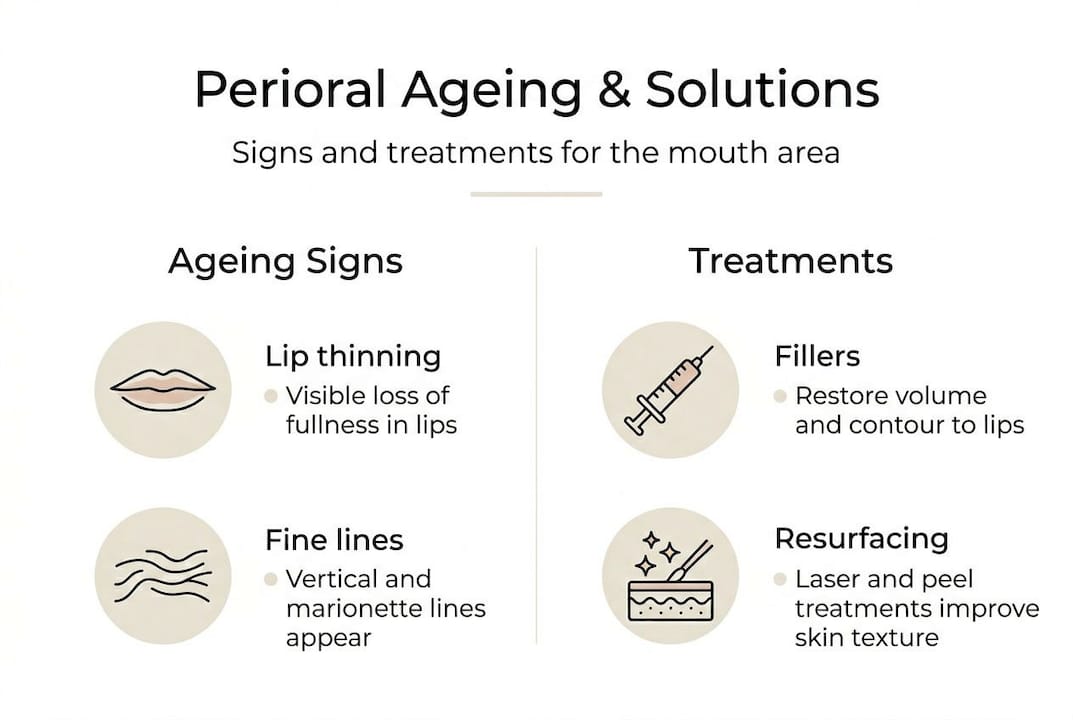
Understanding exactly how ageing manifests around the mouth helps you identify which concerns are most relevant to you. Ageing in this region is driven by a combination of bone resorption, fat compartment changes, collagen loss, and repetitive muscle movement.
Here are the most frequently seen signs:
- Smoker’s lines: Fine vertical lines radiating upward from the lip border. These form due to repeated lip pursing and collagen breakdown, and they are notoriously difficult to treat with skincare alone.
- Blurred lip border: The vermillion border (the defined edge of the lip) loses its crispness, making lips appear less defined and lipstick more prone to bleeding.
- Volume loss in the lips: Lips naturally thin over time as hyaluronic acid and collagen diminish.
- Nasolabial folds: These deepen as cheek volume descends and skin laxity increases.
- Marionette lines: These create a downward pull at the mouth corners, contributing to a tired or stern expression.
- Philtrum elongation: As the upper lip lengthens, less of the lip body is visible, ageing the overall appearance significantly.
The impact of these changes is measurable. Research shows that textural improvement of 56% to 66% is achievable at 13 months following appropriate treatment, demonstrating that meaningful, lasting results are possible. For those experiencing changes across multiple facial zones, full facial rejuvenation may offer the most cohesive outcome.
Non-surgical options for perioral rejuvenation
Non-surgical approaches have advanced considerably and now offer a wide range of solutions suited to different concerns and budgets. Non-surgical methodologies include dermal fillers, anti-wrinkle injections, skin resurfacing, skin boosters, polynucleotides, and Profhilo bioremodelling. Each has its own strengths.
Here is a comparison of the most commonly used options:
| Treatment | Primary benefit | Typical duration | Downtime |
|---|---|---|---|
| Hyaluronic acid fillers | Volume, contour, fold softening | 9 to 12 months | Minimal |
| Anti-wrinkle injections | Smoker’s lines, lip flip | 3 to 4 months | None |
| Profhilo / skin boosters | Hydration, skin quality | 6 months | Minimal |
| Polynucleotides | Collagen stimulation, texture | 6 to 12 months | Minimal |
| Chemical peels | Surface texture, pigmentation | Varies | 3 to 7 days |
For most women, a combination of modalities produces the best outcome. Fillers restore structure and volume, while skin boosters and polynucleotides improve the quality of the skin itself. Anti-wrinkle injections address dynamic lines that fillers cannot fully resolve.
The order in which you approach these treatments matters too. A logical sequence might be:
- Full-face assessment to understand the structural drivers of your concerns
- Structural correction with dermal fillers to restore volume and contour
- Dynamic line treatment with anti-wrinkle injections for smoker’s lines
- Skin quality improvement with skin boosters or polynucleotides
- Maintenance at appropriate intervals to sustain results
One important technical note: intraoral HA filler injection (injecting from inside the mouth) has been shown to reduce pain and adverse events compared to the extraoral approach. This is a technique worth discussing with your practitioner.
Pro Tip: Before committing to any single treatment, ask your practitioner to explain how each element of your plan addresses a specific concern. A well-reasoned, layered approach will always outperform a single isolated procedure. You can also review the benefits of dermal fillers and how they compare in our guide on fillers vs anti-wrinkle injections.
Surgical methods and how they compare
For some women, particularly those with significant skin laxity or structural changes, surgical options may be considered. It is worth understanding how these compare to non-surgical approaches.
| Factor | Non-surgical | Surgical |
|---|---|---|
| Longevity | 6 to 18 months | Several years |
| Downtime | Minimal | Weeks |
| Risk profile | Low with expert technique | Higher (scarring, stiffness) |
| Reversibility | Fillers are reversible | Permanent changes |
| Suitability | Mild to moderate ageing | Moderate to severe laxity |
Surgical options such as lip lifts and deep plane facelifts offer more permanent results but carry risks including scarring, stiffness, and a longer recovery period. These procedures are not appropriate for everyone and require careful candidate selection.
Non-surgical options remain the preferred choice for the majority of women seeking subtle, natural-looking improvement with minimal disruption to daily life.
For those with mild to moderate perioral ageing, non-surgical lip enhancement and complementary injectables will typically deliver excellent results without the risks associated with surgery. The key is realistic expectations and a practitioner who is honest about what each approach can and cannot achieve.
Expert insights: common pitfalls and how to get the best results
Perioral rejuvenation is one of the areas where practitioner skill matters most. The vascularity of the perioral region means that risks, including vascular occlusion (blockage of a blood vessel), are real if technique is poor. Here is what separates excellent outcomes from disappointing ones.
- Always begin with a full-face assessment. Treating the mouth in isolation without considering the cheeks, jawline, and overall facial structure often produces unnatural results. A full-face consultation ensures your plan is coherent.
- Avoid overfilling. More product does not mean better results. Overfilling the lips or perioral area creates an unnatural appearance and can compromise tissue health.
- Insist on cannula technique where appropriate. Cannulas and vein mapping significantly reduce the risk of vascular complications in this high-risk zone.
- Combine modalities thoughtfully. No single treatment addresses all aspects of perioral ageing. A multimodal plan is both safer and more effective.
- Set realistic timelines. Research confirms that 50% to 66% wrinkle reduction is sustainable at one year or more with laser-based treatments, but results build gradually.
Pro Tip: If a practitioner recommends a large volume of filler in a single session without a thorough assessment, treat this as a warning sign. The best results come from conservative, staged treatment guided by clinical judgement.
What to expect before, during and after treatment
Knowing what the process involves helps you feel prepared and confident. Here is a realistic overview of the perioral rejuvenation journey.
Before your appointment:
- A thorough consultation to discuss your concerns, medical history, and goals
- Photographs taken for baseline comparison
- A personalised treatment plan with clear explanation of each step
- Advice on what to avoid beforehand (such as blood-thinning medications or alcohol)
During treatment:
- Topical anaesthetic cream is applied to minimise discomfort
- Where appropriate, intraoral injection technique is used to reduce pain and adverse events
- Most non-surgical perioral treatments take between 20 and 45 minutes
- You remain awake and comfortable throughout
After treatment:
- Mild swelling, redness, or bruising is normal and typically resolves within a few days
- Avoid strenuous exercise, extreme heat, and alcohol for 24 to 48 hours
- Results from fillers are visible immediately, though final results settle over one to two weeks
- Skin booster and polynucleotide results develop gradually over several weeks
- Follow-up appointments allow your practitioner to assess results and make any refinements
Maintenance is an important part of the process. Most filler treatments require a top-up every 9 to 12 months, while skin quality treatments may be repeated every six months depending on your individual response.
Restore your confidence with expert perioral rejuvenation
At Monaz Clinic, we understand that the perioral area requires both precision and artistry. Our approach is always to restore and refresh, never to overdo or alter your natural features.
Based at 96 Harley Street in London, our clinic is dedicated exclusively to women. Mrs Mona Zirak and our GMC-registered clinical team offer personalised perioral rejuvenation plans that may include dermal fillers, anti-wrinkle injections, skin boosters, and polynucleotide therapy. You can review our dermal fillers price list and wrinkle softening price list to understand your options clearly. For those interested in skin quality improvement, our skin rejuvenation treatment with exosomes offers cutting-edge regenerative results. Every journey begins with a complimentary, no-pressure consultation.
Frequently asked questions
How long do results from perioral rejuvenation last?
Most dermal fillers last 9 to 12 months, while laser resurfacing results can persist for more than a year with good aftercare and maintenance. Individual results vary depending on the treatment used and your skin’s response.
Is perioral rejuvenation painful or is there downtime?
Most treatments are well tolerated with topical anaesthetic. Intraoral injection technique has been shown to reduce discomfort and adverse events compared to external approaches, and downtime for non-surgical options is typically just a few days.
What is the safest method for perioral rejuvenation?
Non-surgical treatments performed by an experienced practitioner carry the lowest risk profile. The use of cannulas and vein mapping further reduces the chance of vascular complications in this sensitive area.
Can perioral rejuvenation treat deep lines and folds around the mouth?
Deep folds often require a combination of modalities rather than fillers alone, as fillers cannot provide anatomical lift on their own. A layered approach combining structural support, skin quality treatments, and muscle relaxation typically yields the best outcome.
Are results natural looking?
When guided by thorough assessment and conservative technique, perioral rejuvenation produces subtle, harmonious results. Non-surgical options are specifically favoured for their ability to deliver improvement with minimal downtime and a natural appearance.