




Discover the most effective non-surgical treatments for crow’s feet in London, from Botox to polynucleotides, with clinical evidence and expert guidance from Monaz Clinic.

TL;DR:
- Crow’s feet are caused by thin skin, muscle movements, sun damage, and collagen loss.
- Effective treatments include Botox, fillers, skin boosters, polynucleotides, and microneedling.
- Skill and personalized assessment by practitioners are crucial for natural, lasting results.
Fine lines fanning out from the corners of your eyes are often the first place ageing makes itself known. For many women, they appear in their thirties, deepen through their forties, and become a persistent source of frustration when no amount of eye cream seems to make a real difference. The good news is that modern, non-surgical aesthetic treatments have moved far beyond what topical products can offer. This guide covers the leading in-clinic options available to women in London, what the clinical evidence says about each, and how to approach treatment safely and with realistic expectations.
Table of Contents
- Understanding crow’s feet: why lines form around the eyes
- Essential preparations before treating crow’s feet
- Step-by-step: evidence-based minimally invasive treatments
- Checking your progress: what results to expect and troubleshooting
- What most guides miss about treating crow’s feet
- Enhance your results with expert-led treatments in London
- Frequently asked questions
Key Takeaways
| Point | Details |
|---|---|
| Consult before treating | A qualified professional will assess your skin health, suitability, and risks before recommending crow’s feet treatments. |
| Tailored treatment options | Botox, fillers, polynucleotides, and boosters each suit different skin concerns and outcomes—your choice should match your needs. |
| Track realistic results | Expect visible softening, not total erasure of lines, with optimal results appearing from 1-4 weeks and maintenance needed for best effect. |
| Safety is key | Selecting a skilled practitioner reduces risks of side effects and ensures appropriate aftercare for lasting results. |
Understanding crow’s feet: why lines form around the eyes
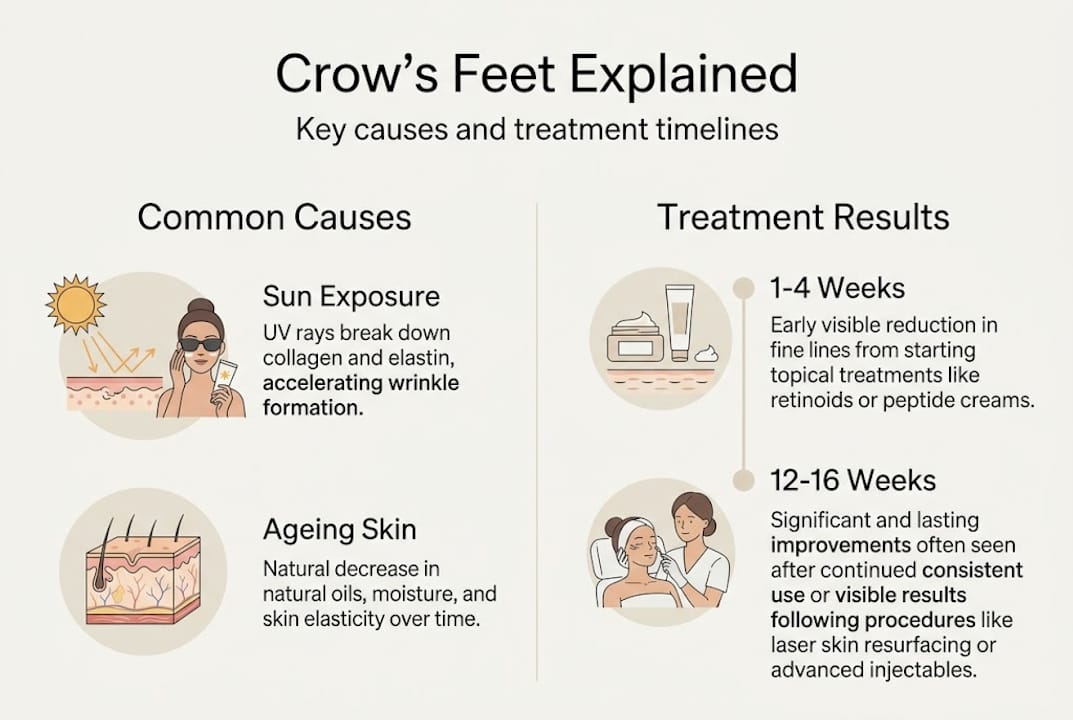
The skin surrounding your eyes is among the thinnest on your entire face, measuring roughly 0.5mm compared to 2mm elsewhere. It contains fewer oil glands, less collagen, and minimal subcutaneous fat to cushion it. This makes it exceptionally prone to creasing, dehydration, and early signs of ageing.
Several factors accelerate the process:
- Repetitive muscle movement: Squinting, smiling, and blinking contract the orbicularis oculi muscle thousands of times daily, gradually etching lines into the skin.
- Sun exposure: UV radiation breaks down collagen and elastin fibres, weakening the skin’s ability to spring back after movement.
- Collagen loss: From your mid-twenties, collagen production declines by roughly 1% per year, reducing skin resilience over time.
- Genetics: Your inherited skin thickness and pigmentation influence how early and how deeply lines form.
- Lifestyle factors: Smoking, poor sleep, and dehydration all accelerate the breakdown of skin structure.
Understanding the causes of crow’s feet helps you choose the right treatment approach. There is an important clinical distinction between dynamic lines, which appear only during facial expression, and static lines, which are visible even at rest. Dynamic lines respond well to muscle-relaxing injections, whilst static lines often require a combination of treatments to address the underlying loss of volume and skin quality.
| Line type | When visible | Primary cause | Best treatment approach |
|---|---|---|---|
| Dynamic | During expression | Muscle movement | Anti-wrinkle injections |
| Static | At rest | Collagen loss, volume deficit | Fillers, skin boosters, polynucleotides |
| Mixed | Both | Combined factors | Layered, multi-treatment plan |
Clinical research confirms that significant wrinkle reduction is achievable within 1 to 16 weeks of targeted treatment, depending on the method chosen. Knowing which type of line you have is the essential first step. You can also explore natural ways to prevent eye wrinkles as a complementary strategy alongside clinical care.
Essential preparations before treating crow’s feet
Having covered why crow’s feet are so common, let’s prepare for what comes next, ensuring a safe, effective treatment journey.
A thorough consultation is non-negotiable before any procedure around the eyes. You should discuss your full medical history, any previous eye conditions such as dry eye syndrome or blepharitis, current medications including blood thinners, and your expectations for the outcome. Being honest about all of this protects you.

Some women are not ideal candidates for certain treatments. A history of severe dry eye, for example, may rule out Botox near the orbital area, as temporary ocular side effects including reduced tear stability and meibomian gland dysfunction can peak around three months post-injection. Mild bruising is also common and should be factored into your plans.
Before your appointment, avoid the following:
- Alcohol for at least 24 hours beforehand
- Aspirin, ibuprofen, and fish oil supplements for 5 to 7 days prior (unless medically prescribed)
- Retinol-based skincare products for 48 hours before treatment
- Heavy eye makeup on the day of your appointment
For tear trough treatments specifically, arriving with clean, product-free skin is particularly important.
| Treatment | Avoid alcohol | Stop blood thinners | Pause retinol | Arrive makeup-free |
|---|---|---|---|---|
| Botox | 24 hrs | 5 days | 48 hrs | Yes |
| Dermal fillers | 24 hrs | 7 days | 48 hrs | Yes |
| Skin boosters | 24 hrs | 5 days | 48 hrs | Yes |
| Polynucleotides | 24 hrs | 5 days | 48 hrs | Yes |
| Microneedling | 24 hrs | 5 days | 5 days | Yes |
Pro Tip: Always disclose any recent eye symptoms, including dryness, irritation, or recent infections, to your clinician before any injectable procedure around the eye area. This single step can prevent the most common complications.
Step-by-step: evidence-based minimally invasive treatments
With the right preparations in place, you’re ready to explore which evidence-backed treatments actually work and what they involve.
Here is how the leading options compare:
- Anti-wrinkle injections (Botox): A small amount of botulinum toxin is injected into the orbicularis oculi muscle using a fine needle. The appointment takes 15 to 20 minutes. Discomfort is minimal. Results from injectable wrinkle softening typically appear within 3 to 5 days and peak at around 30 days, with 67.9% of patients experiencing mild or no visible lines at that point.
- Dermal fillers: Hyaluronic acid gel is placed strategically to restore volume and smooth static lines. Dermal fillers are particularly useful where volume loss is contributing to the appearance of lines. Polycaprolactone (PCL) fillers have shown results noninferior to polynucleotides, with 70% improvement at 12 weeks.
- Skin boosters: Treatments such as Profhilo® and Sunekos deliver deep hydration and stimulate collagen. Skin booster treatments improve overall skin quality rather than targeting specific lines, making them an excellent complement to injectables.
- Polynucleotides: Polynucleotide injections use purified DNA fragments to stimulate cellular repair and regeneration. They are particularly well-suited to thin or fragile skin around the eyes, where volume-adding treatments carry more risk.
- Microneedling: Controlled micro-injuries stimulate collagen production over a series of sessions. Results are gradual but cumulative, improving skin texture and resilience over 3 to 6 months.
Safety note: Clinical evidence advises avoiding Botox if you have a history of dry eye; polynucleotides are the preferred option for thin or fragile periorbital skin. Deeper energy-based treatments such as radiofrequency may suit more advanced lines but carry greater downtime.
| Treatment | Duration of effect | Downtime | Best suited to |
|---|---|---|---|
| Botox | 3 to 4 months | Minimal | Dynamic lines |
| Dermal fillers | 9 to 12 months | 1 to 2 days | Static lines, volume loss |
| Skin boosters | 6 months | Minimal | Skin quality, hydration |
| Polynucleotides | 6 to 9 months | Minimal | Fragile skin, regeneration |
| Microneedling | Cumulative | 1 to 2 days | Texture, collagen building |
Pro Tip: Choose a practitioner with specific experience in advanced eye-area techniques. The periorbital zone is one of the most technically demanding areas to treat, and skill level directly influences both results and safety.
Checking your progress: what results to expect and troubleshooting
Once your treatment is complete, observing the right cues and being aware of benchmarks will help you measure your progress and troubleshoot any concerns.
Timelines vary by treatment. With Botox, you may notice softening within the first week. Clinical data shows a significant drop in crow’s feet grading scores from 2.97 to 1.73 at just one week with a four-point injection pattern, with maximum effect at around 30 days. Fillers and skin boosters show gradual improvement over two to four weeks. Polynucleotides and microneedling require patience, with meaningful results typically visible after two to three sessions.
Results longevity also varies. Botox generally lasts 3 to 4 months, fillers 9 to 12 months, and regenerative treatments such as polynucleotides 6 to 9 months. Scheduling maintenance appointments before results fully fade tends to produce more consistent outcomes over time.
Statistic to note: Up to 67.9% of patients experienced mild or no visible crow’s feet lines at 30 days following Botox treatment. This is a meaningful result, though it is worth noting that individual outcomes depend on line depth, skin quality, and injection technique.
Post-treatment dos and don’ts:
- Do keep the treated area clean and avoid touching it for 6 hours
- Do apply a gentle, fragrance-free moisturiser as recommended
- Do attend your follow-up appointment to assess results
- Don’t exercise vigorously for 24 hours after injectables
- Don’t apply makeup directly over injection sites for 12 hours
- Don’t expose the area to intense heat (saunas, sunbeds) for 48 hours
For ongoing guidance, our aftercare advice for eye treatments provides practical tips to protect and prolong your results.
What most guides miss about treating crow’s feet
Most articles focus on which product or treatment to choose. Far fewer address the factor that actually determines your outcome: the skill and clinical judgement of the person administering your treatment.
We have seen patients who have had Botox elsewhere and returned with results that look flat, overdone, or asymmetrical. The product was not the problem. The assessment, dose, and placement were. This is why we believe that choosing your practitioner is a more important decision than choosing your treatment.
The most natural, lasting results come from a layered approach, addressing muscle activity, volume, and skin quality together rather than treating each in isolation. Patients who understand this, and who commit to a planned programme of care rather than a single session, consistently report the highest satisfaction.
Our honest view: no single appointment erases deep, static lines. Commitment to maintenance, sun protection, and a sensible skincare routine makes the real difference. If you are ready to explore advanced approaches for crow’s feet, the conversation starts with an honest consultation.
Enhance your results with expert-led treatments in London
Armed with knowledge and realistic expectations, you’re ready to choose the best professional help. At Monaz Clinic, located at 96 Harley Street, we offer a full range of evidence-based treatments for crow’s feet and periorbital rejuvenation, delivered exclusively for women in a private, medically supervised setting.

Our practitioners assess each patient individually, combining treatments where appropriate to achieve results that look refreshed rather than altered. You can review our full wrinkle softening price list or visit our dedicated crow’s feet treatment page to learn more. For those with thin or fragile skin around the eyes, our advanced polynucleotide therapy may be the ideal starting point. Book a complimentary consultation to discuss your goals with no pressure and no obligation.
Frequently asked questions
How long does Botox last for crow’s feet around the eyes?
Botox results typically last 3 to 4 months for crow’s feet, with optimal line reduction peaking at around one month after injections, as confirmed by clinical efficacy data across 1 to 16 weeks of follow-up.
Are there any risks with Botox or fillers near the eyes?
Both treatments may cause mild, temporary bruising, and Botox can occasionally affect tear stability; prospective clinical studies confirm these effects are typically temporary, and seeing a medically qualified practitioner minimises your risk significantly.
What is the best non-surgical treatment for thin or fragile under-eye skin?
Polynucleotides are the preferred choice for thin or fragile periorbital skin, as they support cellular regeneration without adding volume or placing undue stress on delicate tissue, as noted in periocular side-effect research.
How soon will I see results after crow’s feet treatment?
With injectables, you may notice improvement within the first week, with maximum effect at approximately one month; grading score data shows a meaningful reduction from 2.97 to 1.73 at just seven days post-treatment.