



38 botulism cases in 2025 exposed real risks in aesthetics. Learn how medical supervision, UK licensing rules, and accredited London clinics keep you safe.

TL;DR:
- Medical supervision ensures patient safety through qualified assessment, proper products, and complication management.
- UK licensing tiers categorize procedures by risk, requiring different levels of professional oversight.
- Verify clinics via CQC registration and practitioner credentials to ensure treatments are safe and legally compliant.
In 2025, 38 botulism cases in England were linked to unlicensed Botox-like products, exposing a deeply uncomfortable truth about the aesthetics industry. Many women assume that because a treatment is non-surgical, it carries minimal risk. The reality is far more complex. From vascular complications to counterfeit injectables, the consequences of receiving treatment from an unqualified or unsupervised provider can be serious and lasting. This guide is written specifically for women in London who want to make informed, confident decisions about aesthetic treatments, covering what medical supervision truly means, how the new 2026 licensing rules work, and how to identify providers you can genuinely trust.
Table of Contents
- Why medical supervision matters in aesthetics
- Understanding the new UK aesthetics licensing rules
- How to identify safe providers and clinics in London
- Special considerations: high-risk procedures and age restrictions
- The reality: what most guides miss about medical supervision in aesthetics
- A supportive, medically supervised experience at Monaz Clinic
- Frequently asked questions
Key Takeaways
| Point | Details |
|---|---|
| Medical supervision protects | Qualified healthcare oversight is essential for safe injectables and skin treatments. |
| Follow 2025 licensing rules | New regulations divide procedures by risk, mandating medical supervision for amber and red tiers. |
| Safe clinic signs | Choose Save Face-accredited, CQC-regulated clinics with GMC/NMC registered staff for guaranteed safety. |
| Avoid high-risk shortcuts | Unlicensed products and practitioners led to botulism outbreaks and complaints—never compromise. |
| Empowered decision-making | Educated women in London can make confident choices by understanding medical supervision frameworks. |
Why medical supervision matters in aesthetics
Medical supervision in aesthetics is not simply a badge or a box to tick. It refers to a structured clinical framework in which a qualified medical professional assesses your suitability for a procedure, oversees the treatment plan, and takes responsibility for managing any complications that arise. This includes a face-to-face consultation before any prescription is issued, proper documentation of your medical history, and access to emergency protocols if something goes wrong.
The importance of this framework became starkly clear following the 2025 botulism outbreak. As new regulations confirm, medical supervision ensures proper assessment, correct prescribing, and complication management, and the botulism cases underscored precisely what happens when these safeguards are absent. Patients received injections in non-clinical settings from individuals with no prescribing authority and no means of managing adverse reactions.
“Medical supervision is not an optional extra in aesthetics. It is the clinical infrastructure that protects patients from harm and ensures that treatments are appropriate, safe, and reversible where possible.”
When you receive a treatment under proper safe cosmetic procedures protocols, several layers of protection are in place:
- A qualified prescriber reviews your medical history and contraindications before any injectable is administered
- The practitioner is trained to recognise and manage vascular occlusions, infections, and allergic reactions
- Products used are licensed, traceable, and stored correctly
- A clear aftercare and emergency escalation pathway exists
- Your records are maintained in a regulated clinical environment
Understanding UK aesthetics regulations is therefore not just a matter of legal compliance. It is a matter of your personal safety. Clinics operating outside this framework may offer lower prices, but the trade-off is a genuine and documented risk to your health.
Understanding the new UK aesthetics licensing rules
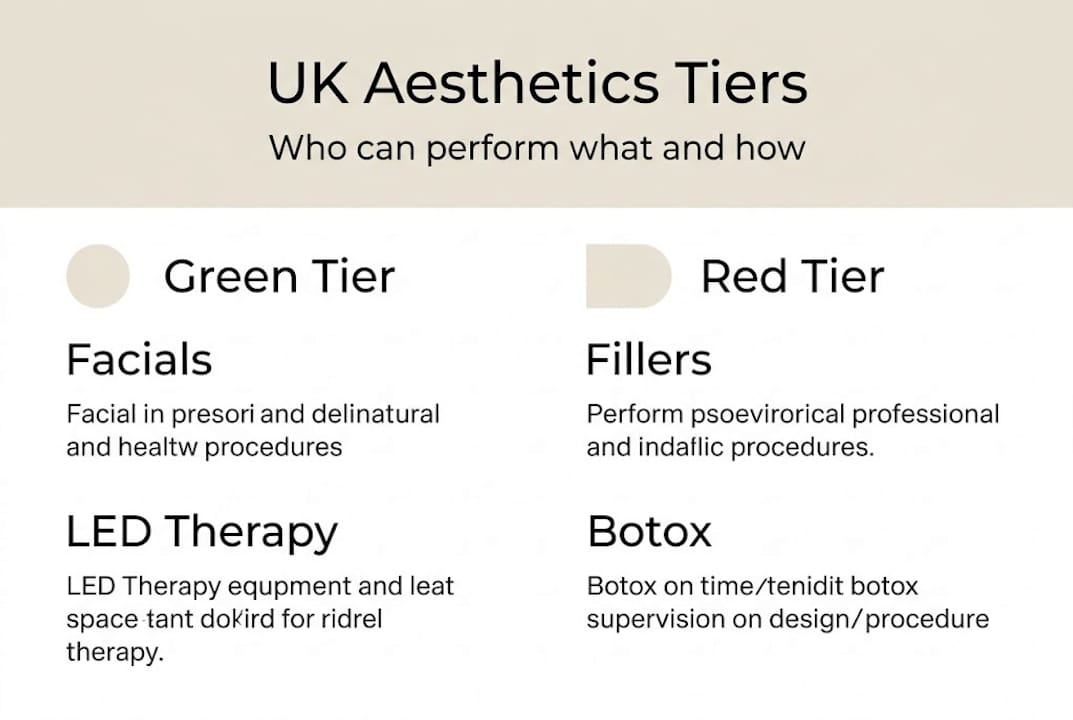
Since 2025, England has operated under a tiered licensing system for non-surgical cosmetic procedures. The 2025 licensing framework categorises procedures by risk level into three tiers: green, amber, and red. The 38 botulism cases that preceded this legislation were a direct catalyst for its introduction.
Here is how the tiers compare:
| Tier | Example procedures | Who can perform | Supervision required |
|---|---|---|---|
| Green | Facials, LED therapy, superficial peels | Trained beauty therapists | None required |
| Amber | Botox, dermal fillers, microneedling | Non-medics with training | Named healthcare professional oversight |
| Red | Thread lifts, BBL, deep chemical peels | Regulated healthcare professionals only | CQC-registered clinic required |
For the treatments most women seek, such as anti-wrinkle injections and fillers, the amber tier applies. This means a non-medic may administer the treatment, but only under the named oversight of a qualified healthcare professional. The government crackdown has made remote prescribing illegal, meaning a prescriber must assess you in person.
If you are considering a treatment, here is the legally required process you should expect:
- A face-to-face consultation with a qualified prescriber, not a video call or online form
- A full review of your medical history, medications, and contraindications
- A cooling-off period between consultation and treatment where appropriate
- Treatment administered by a trained and insured practitioner in a suitable clinical setting
- Written aftercare instructions and a clear route to contact your provider if concerns arise
It is also worth noting a striking statistic: prior to these reforms, 900 complaints were recorded in a single year, with 80% involving unqualified practitioners. Consulting our aesthetic medicine guide and using an aesthetics checklist before booking can help you avoid becoming part of that statistic.
How to identify safe providers and clinics in London
Knowing the legal framework is empowering, but applying it means understanding how to choose safe, medically supervised providers in London. The good news is that credible accreditations and registers exist specifically to help you do this.

Save Face is a PSA-accredited register that has assessed over 12,000 practitioners and 14,000 clinics, and has supported more than 15,000 patients who experienced complications elsewhere. Searching this register before booking is one of the most reliable steps you can take. Similarly, the Care Quality Commission (CQC) regulates clinical environments in England, and any clinic performing red or amber tier procedures should be registered.
Here are five indicators that an aesthetics provider in London is genuinely safe:
- CQC registration is clearly displayed and verifiable on the CQC website
- Practitioners are registered with the GMC, NMC, GDC, or GPhC
- Save Face or equivalent PSA accreditation is held and up to date
- A face-to-face consultation is mandatory before any injectable treatment
- The clinic environment is clean, professional, and equipped for medical emergencies
Conversely, be cautious of clinics offering unusually low prices, operating from non-clinical settings such as private homes or salons, or where the practitioner’s qualifications are vague or unverifiable. Learning how to research facial clinics thoroughly and reviewing best practices in facial aesthetics will help you ask the right questions from the outset.
Pro Tip: Before booking, ask the clinic specifically which professional holds named oversight responsibility for your treatment, and request their GMC or NMC registration number. A reputable clinic will answer this without hesitation. If there is any reluctance, that is a significant warning sign. You can also read our guide to what to expect at a cosmetic consultation to feel fully prepared.
Special considerations: high-risk procedures and age restrictions
For some treatments, extra caution and rules apply, so let us clarify special cases and how medical supervision keeps you safe.
The minimum age for aesthetic procedures in England is 18. The only exception is genuine medical necessity, and in those cases, treatment must be prescribed by a GMC-registered doctor. This rule is firm, and any provider willing to treat someone under 18 for cosmetic reasons is operating outside the law.
For red tier procedures, the requirements are even stricter. Only regulated healthcare professionals working within CQC-registered clinics may carry them out. This includes treatments such as thread lifts and body contouring procedures. The botulinum toxin guidance from BAPRAS also highlights why counterfeit injectable products are particularly dangerous, as they may contain incorrect concentrations or unsterile formulations, which is precisely what caused the 2025 botulism outbreak.
Here is a quick reference for common procedures:
| Procedure | Minimum age | Supervision required |
|---|---|---|
| Anti-wrinkle injections | 18 | Named healthcare professional |
| Dermal fillers | 18 | Named healthcare professional |
| Thread lifts | 18 | Regulated professional, CQC clinic |
| Chemical peels (deep) | 18 | Regulated professional, CQC clinic |
As aesthetics regulations confirm, the minimum age of 18 applies strictly, with only a GMC doctor able to authorise exceptions, and red tier procedures are restricted to regulated professionals only. If you are considering a more complex treatment, follow these steps:
- Confirm the procedure’s tier classification under the 2025 licensing framework
- Verify the practitioner’s registration on the relevant professional register
- Check the clinic holds CQC registration if the procedure is amber or red tier
- Ask specifically about the products being used and request evidence they are licensed in the UK
- Review our guide to side effects of fillers and our injectable aftercare guide before proceeding
The reality: what most guides miss about medical supervision in aesthetics
Most guides focus on whether a clinic meets the minimum legal standard. That is a reasonable starting point, but it is not the full picture. Meeting the legal minimum and genuinely prioritising patient safety are not always the same thing.
The variation in training quality across the industry is significant. Organisations such as BCAM (British College of Aesthetic Medicine) and Save Face advocate for medical-only practitioners for high-risk procedures, going well beyond what the law currently requires. A clinic that voluntarily aligns with these higher standards is making a deliberate choice to put your safety above commercial convenience.
What truly separates an exceptional provider is ongoing education, transparent communication about risks, and a culture where patients are encouraged to ask questions. When you visit a clinic that offers a complete non-invasive procedures list with honest explanations of each treatment’s suitability, that transparency is itself a safety signal.
Pro Tip: Ask your practitioner when they last completed CPD (Continuing Professional Development) in the specific treatment you are considering, and which professional body oversees their training. A confident, qualified practitioner will welcome this question.
A supportive, medically supervised experience at Monaz Clinic
Having learnt what matters in medical supervision, here is where you can confidently choose safe, accredited treatments.
At Monaz Clinic, 96 Harley Street, every treatment is delivered within a fully medically supervised framework, overseen by a GMC-registered doctor. Mrs Mona Zirak and the team follow all 2026 licensing requirements as standard, going further by ensuring every patient receives a thorough consultation, honest advice, and clear aftercare.
Whether you are exploring wrinkle softening treatments, considering dermal fillers, or interested in advanced exosome skin rejuvenation, you will find a private, supportive environment where your wellbeing genuinely comes first. We would love to welcome you for a complimentary, no-pressure consultation at our Harley Street clinic.
Frequently asked questions
Is medical supervision legally required for all Botox and fillers in London clinics?
Yes, since 2025, Botox and fillers as POMs require a face-to-face consultation with a registered prescriber, and remote prescribing is now banned. All treatments must be administered under named medical supervision.
How can I check if a London aesthetics clinic is medically supervised and safe?
Search the Save Face register for verified practitioners and confirm the clinic holds CQC registration. Always check your practitioner’s registration with the GMC, NMC, GDC, or GPhC directly.
What are the age regulations for injectables in London aesthetic clinics?
You must be 18 or older to receive injectable aesthetic treatments. The only exception is genuine medical necessity, which must be prescribed by a GMC-registered doctor.
What is the difference between amber and red tier procedures in UK aesthetics?
Amber tier procedures such as Botox and fillers may be performed by trained non-medics under named healthcare professional oversight. Red tier procedures, including thread lifts, may only be carried out by regulated healthcare professionals within CQC-registered clinics.
Recommended
- 7-Step Facial Aesthetics Checklist for London Ladies – Monaz Clinic London
- Facial Aesthetics: Complete Guide for London Women – Monaz Clinic London
- Facial aesthetics explained: natural enhancement for women 2026 – Monaz Clinic London
- What is anti ageing treatment? A 2026 guide for women – Monaz Clinic London