



Discover the scientific principles that truly define facial beauty. Learn which features matter most and how modern non-surgical treatments enhance natural harmony.

Most people believe mathematical formulas like the golden ratio define facial beauty. Science tells a different story. Research shows that averageness and femininity predict attractiveness far more reliably than any ancient proportion. This guide explores the evidence-backed principles that truly shape facial beauty, how they inform modern non-surgical enhancement, and practical steps you can take to work with your natural features for subtle, harmonious results.
Table of Contents
- The scientific foundation: What makes a face beautiful?
- Breaking down the features: What characterises feminine beauty?
- Cultural myths and the golden ratio: What really matters?
- How health and happiness influence perceived beauty
- Modern aesthetics in practice: Subtle non-surgical enhancement
- Next steps: Personalised facial harmony at Monaz Clinic
- Frequently asked questions
Key Takeaways
| Point | Details |
|---|---|
| Averageness predicts beauty | Facial features close to population norms are more likely to be seen as attractive. |
| Femininity is key | Larger eyes, fuller lips, and soft cheekbones strongly define feminine attractiveness. |
| Golden ratio is overrated | There is little evidence that the golden ratio truly determines facial beauty. |
| Health shines through | Radiant skin and perceived wellbeing make a face look more attractive. |
| Subtle tweaks work best | Small, well-planned non-surgical enhancements can safely boost facial harmony. |
The scientific foundation: What makes a face beautiful?
Facial beauty isn’t random or purely subjective. Modern research identifies three core predictors: averageness, femininity, and symmetry. Averageness refers to prototypical features that align with population norms, creating a sense of familiarity. Femininity encompasses traits like larger eyes, fuller lips, and soft contours. Symmetry measures how evenly features mirror across the face.
Recent studies reveal that averageness and femininity correlate most strongly with rated attractiveness. Symmetry plays a smaller role than commonly assumed. The golden ratio, despite its cultural cachet, has no convincing scientific backing as a beauty standard. Marketing campaigns have inflated its importance, but empirical data shows it’s a poor predictor.
What matters more? Population-specific averageness and health signals. Skin quality, even tone, and radiance communicate vitality. These factors create a foundation for perceived beauty that transcends strict mathematical ratios. Understanding facial harmony means recognising how features work together, not chasing arbitrary measurements.
| Predictor | Correlation with Beauty | Scientific Support |
|---|---|---|
| Averageness | High (r=0.65-0.75) | Strong empirical evidence |
| Femininity | High (r=0.70) | Consistent across studies |
| Symmetry | Moderate (r=0.40-0.50) | Mixed findings |
| Golden Ratio | Weak (r<0.30) | Minimal to none |
This data clarifies where to focus attention. Rather than obsessing over phi proportions, consider how your features align with healthy, balanced norms. Modern practitioners use these insights to guide facial harmonisation treatments that respect individual anatomy whilst enhancing natural beauty.
“The strongest predictors of facial attractiveness are averageness and femininity, not adherence to mathematical ratios. Health cues like skin quality amplify these effects.”
Cultural variations exist, but core patterns recur globally. Faces perceived as beautiful tend to cluster around population averages whilst displaying clear health markers. This principle underpins effective aesthetic enhancement, whether through skincare or subtle non-surgical interventions.
Breaking down the features: What characterises feminine beauty?
Feminine facial features share recognisable patterns. High, soft cheekbones create definition without harsh angles. Fuller, proportionate lips suggest youth and vitality. Large, almond-shaped eyes draw attention and convey openness. Clear, radiant skin signals health. Soft, rounded contours throughout the face contribute to a gentle, approachable appearance.

These traits aren’t arbitrary preferences. Evolutionary psychology suggests symmetry and skin quality indicate health and fertility, making them attractive across cultures. Western research dominates the literature, but similar patterns emerge in diverse populations. The specifics vary, yet the underlying principles remain consistent.
Core feminine facial traits:
- High, soft cheekbones that add structure
- Full lips with balanced upper and lower proportions
- Large eyes with visible whites and defined lashes
- Even skin tone free from blemishes or discolouration
- Soft facial fat distribution creating gentle contours
- Smooth forehead and minimal deep lines
Skin quality deserves special attention. Even the most balanced features lose impact against dull, uneven skin. Radiance comes from proper hydration, sun protection, and cellular turnover. Non-surgical treatments like skin boosters and polynucleotides target these factors directly, improving texture and luminosity without altering structure.
Pro Tip: Prioritise skin health before considering structural enhancements. A consistent routine with SPF, antioxidants, and gentle exfoliation creates the canvas for any aesthetic improvement. Healthy skin amplifies the effect of feminine facial contouring treatments.
Understanding these features helps you identify which aspects of your appearance you might wish to enhance. Modern techniques allow subtle adjustments that work with your natural anatomy rather than imposing foreign ideals. The goal is natural enhancement that preserves your unique identity whilst optimising harmony.
“Feminine beauty is characterised by high cheekbones, full lips, large eyes, clear skin, and soft contours. These features signal health and youth across diverse cultures.”
Cultural context matters. Beauty standards evolve with time and geography, but certain fundamentals persist. Recognising this balance helps you make informed decisions about enhancement that feel authentic rather than trend-driven.
Cultural myths and the golden ratio: What really matters?
The golden ratio (phi, approximately 1.618) has captivated artists and architects for centuries. In recent decades, aesthetic marketing has positioned it as the secret formula for facial beauty. The claim sounds compelling: if your facial proportions match phi, you’ll be perceived as more attractive. The evidence tells a different story.
Scientific studies consistently show that averageness and health cues outperform the golden ratio as beauty predictors. Faces rated most attractive rarely conform to strict phi proportions. Instead, they display balanced features, clear skin, and population-typical characteristics. The golden ratio’s appeal lies more in its mystique than its practical relevance.
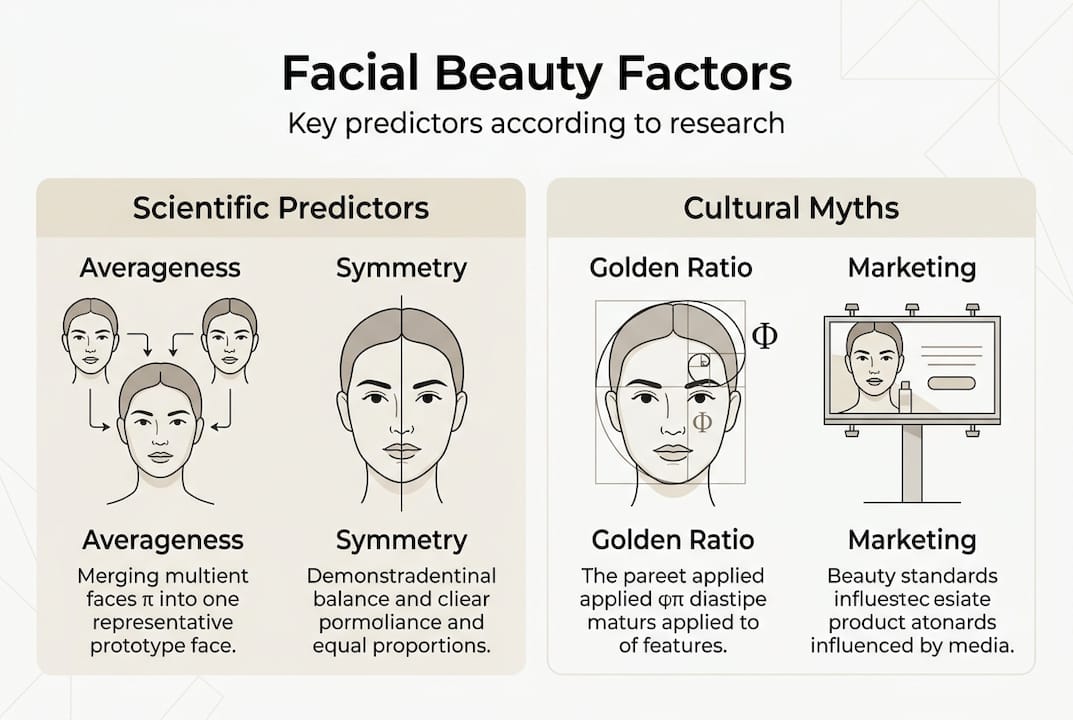
| Factor | Predictive Power | Real-World Application |
|---|---|---|
| Golden Ratio | Low | Minimal clinical use |
| Averageness | High | Guides subtle enhancement |
| Facial Harmony | High | Central to treatment planning |
| Skin Quality | High | Foundation for all aesthetics |
Why does this myth persist? Marketing. Clinics and product lines benefit from offering a simple, quantifiable standard. “Achieve golden ratio proportions” sounds more concrete than “enhance your natural harmony.” Yet the latter approach produces superior, more authentic results.
Statistic: Studies measuring facial attractiveness find correlation coefficients below 0.30 between golden ratio adherence and beauty ratings, whilst averageness and femininity exceed 0.65.
Subtle asymmetry is normal and often charming. Perfectly symmetrical faces can appear uncanny or artificial. The human eye appreciates balance without demanding mirror-image precision. This understanding frees you from chasing impossible standards and allows focus on achievable, meaningful improvements.
Reputable practitioners avoid golden ratio rhetoric. Instead, they assess your individual features, identify areas where subtle enhancement could improve harmony, and use evidence-based techniques to achieve natural results. This approach respects your anatomy whilst optimising proportions in a way that feels authentic.
The scientific analysis is clear: phi is a cultural artefact, not a biological imperative. Understanding this distinction empowers you to evaluate aesthetic advice critically and choose treatments based on genuine evidence rather than marketing myths.
How health and happiness influence perceived beauty
Beauty extends beyond static features. Perceived health plays a crucial role in attractiveness ratings. Skin quality, even tone, and luminescence signal vitality and wellbeing. Research shows attractiveness correlates strongly with health (r=0.61) and femininity (r=0.7), whilst correlating negatively with perceived age.
Skin health assessment involves several factors:
- Tone evenness: Absence of hyperpigmentation, redness, or blotchiness
- Texture smoothness: Minimal visible pores, fine lines, or roughness
- Radiance: Natural glow from proper hydration and cellular turnover
- Clarity: Freedom from active breakouts or congestion
- Elasticity: Firmness and bounce indicating collagen integrity
Facial expressions matter too. Smiling activates muscles that lift the face, creating a more youthful appearance. Happiness shows in the eyes, the set of the mouth, and overall facial relaxation. Chronic stress or fatigue manifests as tension, dullness, and premature ageing signs.
Pro Tip: Prioritise sleep, hydration, and stress management alongside any aesthetic treatments. These lifestyle factors influence skin quality and facial vitality more than most topical products. A well-rested face responds better to enhancement and maintains results longer.
The connection between health and beauty explains why non-surgical treatments focusing on skin quality often produce dramatic improvements. Treatments that boost hydration, stimulate collagen, or improve tone address the fundamental signals of attractiveness. They work with your biology rather than against it.
Skin tone and texture communicate health status. Studies on colour and luminosity show that even subtle improvements in these parameters significantly boost attractiveness ratings. This finding supports the value of treatments like skin boosters, exosome therapy, and professional skincare regimens.
Vitality shows. A face that looks rested, nourished, and content will always outperform one with perfect proportions but visible stress or fatigue. This holistic view of beauty guides modern aesthetic practice, where structural enhancement complements rather than replaces health optimisation.
Modern aesthetics in practice: Subtle non-surgical enhancement
Contemporary aesthetic medicine applies scientific principles through precise, minimally invasive techniques. Dermal fillers restore volume to cheeks, lips, and chin, creating balanced proportions. Botulinum toxin relaxes overactive muscles, softening lines and improving facial symmetry. Skin treatments address texture, tone, and radiance.
The process begins with facial analysis. Practitioners assess your features using established frameworks like facial thirds and fifths. These divisions help identify areas where subtle adjustment could improve harmony. The goal isn’t to impose a template but to optimise your individual proportions.
Best outcomes follow anatomy-guided principles. Practitioners who understand facial structure, fat compartments, and ageing patterns can predict how treatments will integrate with your natural features. This expertise prevents the overdone, artificial results that occur when technique ignores biology.
Key principles for natural results:
- Start conservatively and build gradually over multiple sessions
- Respect your natural bone structure and soft tissue distribution
- Prioritise balance and proportion over isolated feature enhancement
- Choose practitioners who assess your whole face, not just problem areas
- Maintain realistic expectations about what non-surgical methods can achieve
London clinics specialising in female aesthetics emphasise subtlety. The aim is to look like yourself, refreshed and harmonised, not like someone else. Treatments like cheek enhancement or subtle facial adjustments work best when they’re nearly invisible, creating an overall impression of vitality rather than obvious intervention.
Modern techniques allow remarkable precision. Micro-droplet injection, cannula placement, and layered approaches enable practitioners to sculpt with millimetre accuracy. This precision makes the difference between enhancement that looks natural and treatment that appears artificial. Examples of non-surgical facelifts demonstrate what’s possible when skill meets science.
The best results come from treating the face as an interconnected system. Improving one area often requires subtle adjustments elsewhere to maintain balance. This holistic approach, grounded in the scientific principles discussed earlier, produces outcomes that enhance your natural beauty rather than fighting against it.
Next steps: Personalised facial harmony at Monaz Clinic
At Monaz Clinic, we apply these evidence-based principles to create bespoke enhancement plans for women seeking natural, harmonious results. Our approach begins with understanding your unique facial anatomy, aesthetic goals, and lifestyle considerations. We never impose generic templates or chase arbitrary ratios.
Our wrinkle softening treatments use precise botulinum toxin placement to relax overactive muscles, creating smoother contours whilst preserving natural expression. For volume restoration and contouring, our dermal filler options target cheeks, lips, chin, and jawline with techniques that respect your individual proportions.
Skin quality forms the foundation of facial beauty. Our skin rejuvenation treatments, including exosome therapy, polynucleotides, and advanced microneedling, address texture, tone, and radiance at a cellular level. These treatments complement structural enhancements, ensuring your skin matches the harmony of your features.
Every journey begins with a complimentary consultation at our Harley Street location. We take time to listen, assess, and create a plan that aligns with your goals. Whether you’re considering your first treatment or seeking to refine previous work, we’re here to guide you with expertise, honesty, and care.
Frequently asked questions
Is facial symmetry the key to beauty?
Symmetry influences attractiveness, but averageness and femininity are stronger, more reliable predictors according to scientific studies.
What are the most attractive features in a woman’s face?
High cheekbones, full lips, large eyes, clear even skin, and soft facial contours are most consistently linked with femininity and perceived beauty.
Does the golden ratio really define a beautiful face?
No. The golden ratio lacks scientific support as a beauty standard; averageness and health cues predict attractiveness far more accurately.
Can non-surgical treatments enhance facial harmony naturally?
Yes. Subtle, anatomy-based enhancements with fillers or rejuvenation techniques safely improve proportions whilst respecting your natural features.
How important is skin quality for facial attractiveness?
Skin quality is crucial. Attractiveness correlates positively with perceived health and radiant, even-toned skin signals vitality effectively.
Recommended
- Facial Harmony: How Balance Shapes Confidence – Monaz Clinic London
- Facial aesthetics explained: natural enhancement for women 2026 – Monaz Clinic London
- Facial Assessment Checklist for Natural-Looking Results – Monaz Clinic London
- Natural results start here: facial assessment explained – Monaz Clinic London